WhatsApp Cloud API Pricing in India: Complete Cost Guide 2026
Understand WhatsApp Cloud API pricing in India, including LeadWA setup fees, message usage, utility and marketing costs, integrations and additional pricing considerations.
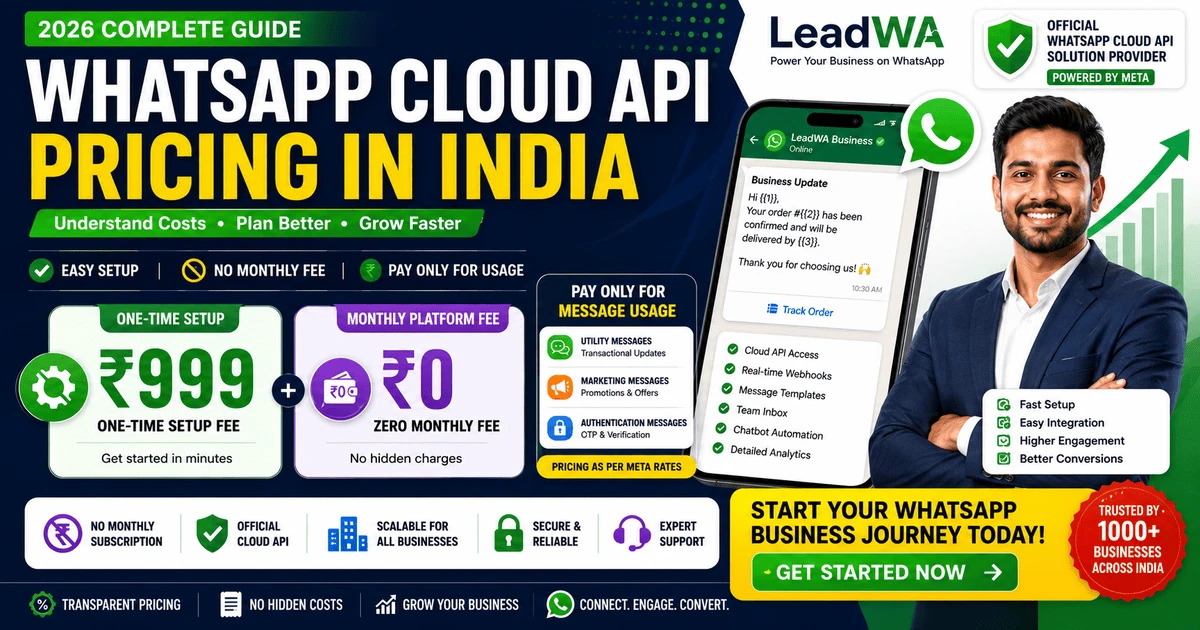
Table of Contents
Introduction
WhatsApp Cloud API pricing in India can appear complex at first glance. With platform setup fees, message usage charges, different message categories and varying provider models, understanding the complete cost picture is essential before making a decision.
This guide explains how WhatsApp Cloud API pricing works in clear, practical terms. Whether you are a small business, an ecommerce store, a service provider, or a growing enterprise, understanding these cost components helps you plan your messaging budget effectively.
Key pricing components include:
- Platform setup cost – The initial fee to access the platform
- Message usage cost – Charges for sending messages based on category and volume
- Integration costs – Connecting with CRM, websites and other business systems
- Additional costs – Taxes, third-party services and custom requirements
This guide is written for:
- Small and medium businesses
- Ecommerce stores
- Service businesses
- Education and coaching providers
- Healthcare organisations
- Customer-support teams
- Marketing teams
- Growing enterprises
Remember that final pricing depends on platform setup, message usage, selected message category, chosen message pack, business requirements, custom integration needs and applicable taxes and terms.
What you will learn in this guide:
- LeadWA platform setup cost (currently ₹999 one-time)
- Monthly platform subscription information (currently ₹0)
- Message-category pricing (utility, marketing, authentication)
- Message-pack examples and pricing considerations
- Additional costs to consider
- Integration costs and considerations
- Budget-planning guidance
- Plan-selection checklist
1. What Is WhatsApp Cloud API?
WhatsApp Cloud API is a cloud-hosted business messaging API that allows eligible businesses to connect WhatsApp communication with websites, CRM systems, customer-support tools and automated workflows.
Possible capabilities include:
- Business messaging – Send and receive messages with customers
- Message templates – Use approved templates for structured communication
- Customer-support workflows – Manage support tickets and enquiries
- CRM connectivity – Synchronise customer data with business systems
- Website integration – Connect website enquiry forms with WhatsApp
- API access – Programmatic access for custom solutions
- Webhooks – Receive real-time event notifications
- Shared team communication – Collaborate on customer conversations
- Chatbot automation – Automate common customer interactions
- Communication analytics – Track message activity and engagement
Note: Available features depend on the selected LeadWA plan, business setup, account eligibility, technical configuration and implementation requirements.
2. How Does WhatsApp Cloud API Work?
Understanding the workflow helps businesses plan their integration effectively.
Customer
Sends message
Infrastructure
Cloud API
Processes event
LeadWA
Platform
Business
Systems
Simplified workflow illustration. Actual architecture depends on configuration and implementation.
A typical workflow involves:
- Customer communicates – Through WhatsApp
- WhatsApp infrastructure processes – The communication
- Cloud API sends relevant events – To the connected platform
- LeadWA processes applicable events – And workflows
- CRM, chatbot, webhook or support-team actions – May occur
- The response is delivered – Through the connected WhatsApp infrastructure
Note: Actual workflow depends on configuration, message type, connected systems and implementation requirements.
3. How WhatsApp Cloud API Pricing Works
Understanding the pricing structure helps businesses plan their communication budget effectively.
LeadWA Platform Setup
₹999
One-time platform setup fee
Current LeadWA pricing model
Monthly LeadWA Platform Subscription
₹0
No monthly LeadWA platform subscription fee
Message usage charged separately
Message Usage
Charged Separately
Based on selected message pack
Utility, marketing, authentication
Optional Additional Requirements
Varies
Taxes, integrations, third-party services
Depends on business requirements
Educational Cost Formula
Estimated Initial Implementation Cost =
LeadWA Platform Setup + Selected Message Pack + Applicable Taxes + Optional Integration or Third-Party Costs
This formula is for general planning. Actual pricing depends on current products, message usage, selected features and implementation requirements.
4. LeadWA WhatsApp Cloud API Setup Cost
The WhatsApp Cloud API setup cost covers the technical onboarding, configuration and access to the WhatsApp Cloud API through LeadWA.
LeadWA Platform Setup
One-time LeadWA platform setup
Possible setup areas include:
- Initial onboarding
- Platform configuration
- Business-information guidance
- Applicable dashboard setup
- Technical onboarding
Note: The setup fee covers platform access and configuration. Message usage is charged separately based on the selected message pack.
5. What May Be Included in LeadWA Platform Setup?
Understanding what the ₹999 setup fee may cover helps businesses evaluate the platform.
| Setup Area | Possible Scope | Important Note |
|---|---|---|
| Platform onboarding | Initial account setup and configuration | Guided assistance provided |
| Dashboard configuration | Access to the LeadWA dashboard | User-friendly interface |
| Shared inbox configuration | Team collaboration setup | Capabilities depend on plan |
| Message-template guidance | Assistance with template creation and submission | Approval not guaranteed |
| Chatbot and automation setup | Configuration of automation tools | Basic configuration included |
| API connectivity guidance | Integration planning and guidance | Custom integrations may vary |
| Webhook planning | Webhook configuration guidance | Implementation may require additional work |
| CRM integration planning | Integration planning assistance | Custom integration may involve additional costs |
| Technical onboarding assistance | Setup and configuration support | Available during onboarding |
Note: The exact scope depends on the selected LeadWA product, current plan terms and implementation requirements. Confirm the applicable scope before purchase.
6. What Is Not Automatically Included?
The setup fee should not automatically be interpreted as including everything. The following are generally not included:
- Unlimited message usage – Message usage is charged separately
- Every message pack – Message packs are purchased separately
- Applicable taxes – GST may apply
- Custom software development – Development work may involve separate charges
- Every CRM integration – CRM integration may involve additional work
- Every ecommerce integration – Ecommerce integration may involve additional work
- Third-party subscriptions – CRM and other platforms have their own fees
- External hosting – Hosting costs are separate
- Domain registration – Domain costs are separate
- Third-party software fees – Other software may have separate fees
- Custom chatbot development – Advanced chatbot development may involve additional costs
- Guaranteed Meta approval – Approval is not guaranteed
- Guaranteed Green Tick – Green Tick approval is determined by Meta
- Guaranteed message delivery – Delivery depends on various factors
- Guaranteed business results – Results depend on many factors
Important: Review the current pricing page and confirm setup scope, message-pack validity, integration requirements and applicable charges before purchase.
7. Does LeadWA Charge a Monthly Platform Subscription?
Monthly Platform Subscription
No monthly LeadWA platform subscription fee under the current pricing model
Under the current LeadWA pricing model, there is no monthly platform subscription fee. You pay a one-time platform setup fee and then only for message usage based on your selected message pack.
Important: ₹0 monthly platform fee does not mean all future usage is free. Message usage, taxes, third-party services and optional technical work may still involve charges.
Review current WhatsApp Business API pricing for the latest information.
8. WhatsApp Message Categories Explained
WhatsApp messages are generally classified into different categories. Understanding these categories helps businesses choose the right message packs.
Utility Messages
Transactional communication such as order confirmations, shipping updates, payment notifications and appointment reminders.
Generally used for customer-requested or transaction-related updates
Marketing Messages
Promotional communication such as offers, product announcements, customer engagement and seasonal campaigns.
Requires appropriate customer opt-in consent
Authentication Messages
Verification workflows such as one-time passwords, account verification, login verification and security-related authentication.
Used for secure identity verification
Service Conversations
Direct customer interactions such as answering enquiries, providing product support, order assistance and human-agent replies.
May follow different pricing rules
Note: Message classification and applicable pricing may depend on current WhatsApp requirements, message content, customer interaction and business context.
9. WhatsApp Cloud API Message Usage Pricing
Message usage is the primary ongoing cost of WhatsApp Cloud API. Pricing varies based on the message category (utility, marketing, authentication) and the message pack you select.
Important: Message-pack availability, pricing, validity periods and commercial terms may change. Review current LeadWA pricing before purchase.
Utility Message Packs
Utility messages include order confirmations, shipping updates, payment notifications, appointment reminders and account-related updates. These are transactional messages that customers typically expect to receive.
Marketing Message Packs
Marketing messages are used for promotional campaigns, offers, product announcements and customer engagement. These messages require opt-in consent from recipients.
Authentication Message Packs
Authentication messages are used for verification workflows such as one-time passwords, account verification, login verification and security-related authentication.
Note: Message-pack availability, pricing, validity and usage conditions should be checked before purchase. Prices, message-pack availability, validity periods and commercial terms may change. Review the current pricing page or contact LeadWA before purchase.
10. How to Estimate Your Monthly Message Usage
Estimating your messaging volume helps you choose the right message pack.
Estimation Steps
- Estimate the number of customers contacted each month – Calculate your typical customer base
- Estimate relevant messages per customer – Determine average communication frequency
- Separate expected communication by message category – Identify utility, marketing and authentication needs
- Consider seasonal demand – Account for peak periods
- Compare estimated volume with available message packs – Choose appropriate pack size
Educational Formula
Estimated Monthly Message Volume =
Number of Relevant Customer Communications × Average Messages per Communication
Illustrative Examples
Small Service Business
Typical needs: Appointment reminders, booking confirmations, customer enquiries
Estimated messages: 500–1,000 per month
Recommended: Small utility pack
Illustrative example only
Ecommerce Store
Typical needs: Order confirmations, shipping updates, payment notifications, support enquiries
Estimated messages: 2,000–5,000 per month
Recommended: Medium utility pack
Illustrative example only
Customer-Support Team
Typical needs: Support enquiries, follow-ups, case updates, satisfaction surveys
Estimated messages: 1,000–3,000 per month
Recommended: Utility + marketing packs
Illustrative example only
Note: Illustrative planning examples only. Actual message usage and pricing vary. Prices, message-pack availability, validity periods and commercial terms may change.
11. WhatsApp Cloud API Pricing for Small Businesses
WhatsApp Business API for small businesses can be a cost-effective solution with the right planning.
Small businesses should consider:
- Starting with realistic communication volume based on current customer needs
- Avoiding unnecessary message volume
- Selecting an appropriate pack that matches expected usage
- Planning message costs separately from platform setup
- Reviewing customer-support requirements
- Considering integration requirements
Tip: Small businesses can start with smaller message packs and scale as their communication needs grow.
12. WhatsApp Cloud API Pricing for Ecommerce
Ecommerce businesses can benefit from WhatsApp Cloud API for various communication workflows:
- Order confirmations: Confirm customer orders with details
- Payment information: Send payment confirmation and receipts
- Shipping notifications: Provide tracking information
- Delivery updates: Notify about successful delivery
- Customer-support enquiries: Handle post-purchase questions
- Relevant promotional communication: Share offers with appropriate consent
Order volume directly influences message requirements. Businesses should estimate message needs based on:
- Average monthly orders
- Expected shipping updates per order
- Customer-support enquiry volume
- Planned promotional campaigns
Note: Ecommerce pricing depends on message category and selected pack. Review historical order and enquiry data to estimate message requirements.
13. WhatsApp Cloud API Integration Costs
Integration costs may vary depending on several factors:
- Existing website technology: Integration complexity depends on the website platform
- CRM platform: Different CRM systems have different integration requirements
- Ecommerce system: Ecommerce platforms may require custom integration
- API availability: API support determines integration feasibility
- Webhook requirements: Webhook configuration may require technical work
- Custom workflows: Business-specific workflows may require development
- Data synchronisation: Data mapping and synchronisation may be needed
- Security requirements: Security implementation may involve additional work
- Testing: Integration testing is important for reliable operation
- Maintenance: Ongoing integration maintenance may be required
Note: Simple configuration and custom software development are not necessarily the same service. Custom development may require separate assessment and pricing.
14. CRM, Website and Webhook Integration Considerations
WhatsApp CRM software integration enables businesses to manage customer relationships more effectively.
Key integration areas:
- CRM integration: Synchronise customer data, manage leads and track conversations
- Website integration: Connect website enquiry forms with WhatsApp workflows
- Webhook configuration: Receive real-time event notifications
- Customer-data synchronisation: Keep customer data consistent across systems
- Event-driven workflows: Automate processes based on customer interactions
- Technical testing: Verify integration reliability
Note: Integration availability depends on the specific platform, API support, technical implementation and connected systems. Cloud API and webhook integration capabilities may vary.
15. Chatbot and Automation Cost Considerations
WhatsApp chatbot for business integration helps automate customer interactions.
Cost factors include:
- Basic auto-replies: Simple automated responses
- FAQ automation: Automated answers to common questions
- Lead qualification: Automated lead qualification workflows
- Workflow complexity: More complex workflows may require additional configuration
- External AI services: Third-party AI services may involve additional costs
- Custom business logic: Business-specific logic may require development
- CRM connectivity: Connecting chatbots with CRM systems
- Ongoing optimisation: Continuous improvement may require maintenance
Note: Advanced custom automation may require additional technical work or third-party services. Chatbot capabilities depend on the selected LeadWA plan and configuration.
16. WhatsApp Cloud API vs WhatsApp Business App
Understanding the differences helps businesses choose the right solution:
| Feature | WhatsApp Business App | WhatsApp Cloud API |
|---|---|---|
| Intended use | Small businesses, single users | Growing businesses, teams |
| API access | ✗ No | ✓ Yes |
| Automation | Basic automated replies | Advanced automation workflows |
| Webhooks | ✗ No | ✓ Yes |
| CRM integration | ✗ No | ✓ Yes |
| Shared team workflow | Limited multi-device access | Advanced team workflows |
| Message templates | Quick replies only | Approved message templates |
| Technical setup | Simple app installation | Guided onboarding available |
| Business scalability | Limited | Scalable |
| Typical business use | Very small businesses | Growing businesses, enterprises |
Note: Each option serves different requirements. Businesses should choose based on their specific needs, team size and communication volume.
17. WhatsApp Cloud API vs LeadWA Bulk Campaign
LeadWA Bulk Campaign is a separate campaign solution. It does not use WhatsApp Cloud API.
| Feature | WhatsApp Cloud API | LeadWA Bulk Campaign |
|---|---|---|
| Cloud API connectivity | ✓ Yes (Meta Cloud API) | ✗ No |
| Business onboarding | ✓ Required | ✗ Not required |
| Message workflow | Utility, Marketing, Authentication | Marketing Only |
| Shared inbox | ✓ Yes | ✗ No |
| Chatbot support | ✓ Yes | ✗ No |
| CRM integration | ✓ Yes | ✗ No |
| Webhooks | ✓ Yes | ✗ No |
| Campaign tools | ✓ Yes | ✓ Yes |
| Intended use | Business Automation | Campaign Outreach |
Important: Bulk Campaign is a separate solution and does not use the official WhatsApp Cloud API. Features, onboarding and account behaviour may differ. Businesses should choose according to their communication requirements, customer-consent practices, technical needs and applicable platform requirements.
18. Additional Costs to Consider
Beyond the platform setup and message usage costs, businesses should consider these additional cost areas:
- Applicable GST: GST may apply to platform setup fees and message packs based on current tax regulations
- Message usage: Ongoing message costs based on selected pack
- Message-pack validity: Credits may have expiry periods
- Custom integration: Connecting with custom applications may involve additional costs
- CRM subscriptions: CRM platforms have their own fees
- Ecommerce-platform costs: Ecommerce platforms may have their own costs
- Third-party software: Other software tools may have separate fees
- External hosting: Webhook endpoints and hosting may involve separate costs
- Custom chatbot development: Advanced chatbot configuration may require additional time
- Staff training: Team members may need training on the platform
- Technical maintenance: Ongoing technical maintenance may be required
- Optional support requirements: Some support may be charged separately
Note: Not all businesses will pay every cost. Costs depend on business requirements, selected services and implementation needs.
19. How to Choose a Suitable WhatsApp API Plan
Follow this checklist to choose the right plan for your business:
- Estimate monthly message volume: Calculate typical message needs
- Identify communication categories: Determine utility, marketing and authentication needs
- Review available packs: Check pack sizes and pricing
- Check pack validity: Understand credit expiration periods
- Review current pricing: Get up-to-date pricing information
- Check customer-consent requirements: Ensure consent for marketing messages
- Understand template requirements: Check applicable template rules
- Review monthly platform charges: Confirm recurring fees
- Check integration requirements: Consider integration needs
- Consider seasonal volume: Account for peak periods
- Confirm taxes: Factor in applicable GST
- Confirm onboarding scope: Understand setup support
- Review technical-support requirements: Consider ongoing support needs
Tip: Choose based on actual business requirements rather than only the lowest advertised price. Consider usage patterns and growth plans.
20. Questions to Ask Before Purchasing
Before purchasing, consider asking these questions:
- Is the setup fee one-time? Confirm the payment structure
- Is there a monthly LeadWA platform subscription? Check recurring fees
- Are message packs included? Understand what is covered
- What is the message-credit validity? Check expiration periods
- Which message categories are available? Confirm utility, marketing, authentication availability
- Are taxes included? Understand tax applicability
- Is custom development included? Check development scope
- Is CRM integration included? Understand CRM integration support
- Are third-party services separate? Identify other potential costs
- What onboarding support is provided? Check setup assistance
- What business and number requirements apply? Understand eligibility
- What happens after message credits are used? Understand usage process
- What support is available after setup? Understand ongoing support
- Which terms apply to refunds and cancellations? Review terms
Note: Answers depend on the provider, plan and current commercial terms. Review all details before purchase.
21. Frequently Asked Questions
What is WhatsApp Cloud API?
WhatsApp Cloud API is a cloud-hosted business messaging API that allows eligible businesses to connect WhatsApp communication with websites, CRM systems, customer-support tools and automated workflows. It provides secure and scalable messaging capabilities through Meta's infrastructure.
How much does WhatsApp Cloud API cost in India?
WhatsApp Cloud API cost in India includes a one-time platform setup fee starting from ₹999 with LeadWA. There are no monthly platform subscription charges. Message usage costs vary based on the selected message category and pack.
What is the LeadWA Cloud API setup cost?
LeadWA currently offers a one-time platform setup fee of ₹999 for WhatsApp Cloud API integration. This covers initial onboarding, platform configuration and guided setup assistance.
Is the ₹999 setup fee a one-time payment?
The current LeadWA pricing model lists this as a one-time platform setup fee. Message usage charges, taxes, custom integrations and third-party services are charged separately.
Does LeadWA charge a monthly platform subscription?
No. Under the current LeadWA pricing model, there is no monthly platform subscription fee. You pay a one-time setup fee and then only for message usage based on your selected message pack.
Does ₹0 monthly platform fee mean message usage is free?
No. ₹0 monthly platform fee means there is no monthly LeadWA platform subscription. Message usage charges apply separately based on your selected message pack. Taxes, custom integrations and third-party services may also involve additional costs.
Are messages included in the setup fee?
No. The setup fee covers platform access and configuration. Message packs are purchased separately based on your communication needs. Message usage charges apply according to the selected pack and applicable terms.
How are WhatsApp Cloud API message costs calculated?
Message usage charges may depend on message category, selected LeadWA pack, applicable WhatsApp pricing rules and current commercial terms. Utility, marketing and authentication messages may have different pricing. Message availability and rates may change over time.
What are utility messages?
Utility messages are transactional communications such as order confirmations, shipping updates, payment notifications, appointment reminders and account-related updates. These are messages that customers typically expect to receive as part of a transaction or service.
What are marketing messages?
Marketing messages are promotional communications such as offers, product announcements, customer engagement and seasonal campaigns. These messages require appropriate customer opt-in consent and must comply with applicable WhatsApp policies.
What are authentication messages?
Authentication messages are used for verification workflows such as one-time passwords (OTPs), account verification, login verification and security-related authentication. These messages help businesses verify customer identities securely.
What are service conversations?
Service conversations are direct customer interactions such as answering enquiries, providing product support, order assistance and human-agent replies. These conversations may follow different pricing rules compared to business-initiated messages.
Are message-pack prices permanent?
Prices, message-pack availability, validity periods and commercial terms may change. Review the current pricing page or contact LeadWA before purchase. Message credits are generally valid for a specified period as per the terms of the selected pack.
How long are message credits valid?
Message credits are generally valid for a specified period. Check the terms before purchase. Credit validity may vary by pack type and current commercial terms.
Does GST apply?
Yes, applicable GST may apply to platform setup fees and message packs based on current tax regulations. Review the applicable tax rates with LeadWA before purchase.
Are custom integrations included?
Custom integrations with specific CRM, ecommerce or business systems may involve additional costs depending on the scope and technical requirements. Review integration requirements with LeadWA before purchase.
Can WhatsApp Cloud API connect to a CRM?
Yes, the WhatsApp Business Platform supports CRM integration through REST APIs and webhooks. This allows businesses to synchronise customer data, manage leads and track conversations within their existing CRM systems. Integration availability depends on the CRM platform, API support and technical implementation.
Can WhatsApp Cloud API connect to a website?
Yes, businesses can integrate WhatsApp Cloud API with their websites through entry-point links, website forms connected to business workflows, or custom API-based application integration. Integration capabilities depend on the website platform and technical implementation.
Does WhatsApp Cloud API support webhooks?
Yes, webhooks enable real-time event notifications for incoming messages, message-status updates, customer responses and other relevant events. This allows businesses to automate workflows and integrate with business systems.
Can I use chatbot automation?
Yes, the WhatsApp Business Platform supports chatbot automation for handling frequently asked questions, lead qualification, customer routing, business-hour messages, appointment workflows and structured customer communication. Chatbot capabilities depend on the selected plan and configuration.
Can multiple team members manage customer communication?
Yes, the WhatsApp Business Platform supports shared team inboxes that allow multiple team members to collaborate, assign conversations, and respond to customers from a single platform, depending on the provider and plan.
Is WhatsApp Cloud API suitable for small businesses?
Yes, the WhatsApp Business Platform is designed for businesses of all sizes, including small and medium businesses. With providers like LeadWA, small businesses can access the Cloud API with a one-time setup fee and no monthly platform subscription.
How can ecommerce businesses estimate message volume?
Ecommerce businesses can estimate message usage based on monthly order volume, expected shipping updates, customer-support enquiries and planned promotional communication. Review historical order and enquiry data to estimate message requirements.
What is the difference between Cloud API and WhatsApp Business App?
The WhatsApp Business App is a free mobile application designed for small businesses with basic features, while the WhatsApp Cloud API is an API-based business messaging solution designed for businesses that need scalable communication, automation, team workflows and integrations.
What is the difference between Cloud API and LeadWA Bulk Campaign?
The Cloud API uses Meta's official infrastructure and supports features like AI chatbots, shared inbox, CRM integration and automation. Bulk Campaign is a separate campaign solution designed for high-volume messaging without the same verification requirements. Bulk Campaign does not use the official WhatsApp Cloud API.
Can I use an existing WhatsApp number?
An eligible existing business number may be connected or migrated, depending on its current WhatsApp setup and Meta requirements. Contact your platform provider for migration guidance before starting the migration process.
Does LeadWA guarantee Meta approval?
LeadWA provides guidance and setup assistance but does not guarantee Meta verification, display-name approval or Green Tick approval. Final decisions are made by Meta based on their eligibility criteria and business verification requirements.
Does LeadWA guarantee Green Tick approval?
We provide guidance and support for the Green Tick application process. Final approval is determined by Meta based on their eligibility criteria and business verification requirements.
How do I choose a suitable message pack?
Choose a message pack based on your estimated monthly message volume, message categories (utility, marketing, authentication), budget, and business requirements. Consider seasonal demand, customer communication needs and available pack validity periods.
Can I review LeadWA before purchasing?
Yes, LeadWA provides guided onboarding and setup assistance. Businesses can review available features and pricing before making a purchase decision. Contact our team to learn more.
22. Final Recommendation
WhatsApp Cloud API integration pricing should be evaluated using:
- Platform setup cost: One-time fee for initial onboarding
- Monthly platform subscription: Recurring platform fees (₹0 with LeadWA)
- Expected message volume: Estimated monthly communication needs
- Message categories: Utility, marketing, authentication requirements
- Message-pack validity: Credit expiration periods
- Applicable taxes: GST and other applicable taxes
- Integration requirements: Website, CRM, ecommerce integration needs
- Third-party costs: CRM, ecommerce and other software fees
- Technical support needs: Onboarding and ongoing assistance
LeadWA's current pricing model may be suitable for businesses that prefer a one-time platform setup fee without a monthly LeadWA platform subscription, while paying separately for message usage and other applicable requirements.
However, every business is different. We encourage you to compare:
- Features: What capabilities does each provider offer?
- Support: What level of onboarding and technical support is available?
- Integration scope: Which business systems can be connected?
- Message pricing: What are the per-message rates for your expected categories?
- Commercial terms: What are the contract terms, validity periods and conditions?
Key Takeaway: Understanding WhatsApp Cloud API pricing in India helps you make an informed decision. With LeadWA's one-time platform setup model and no monthly subscription fee, businesses can access the Cloud API while paying separately for message usage and additional requirements.
Related Guides
Explore more WhatsApp Business API resources:
WhatsApp Business API Cost in India
Detailed breakdown of WhatsApp Business API pricing, setup costs and message charges.
How to Get WhatsApp Business API in India
Complete step-by-step guide for Indian businesses to get WhatsApp Business API.
WhatsApp Business API Message Templates
Explore 50+ message template examples and approval guidance.
15 Benefits of WhatsApp Business API
Discover the key benefits of WhatsApp Business API for customer support, automation and team collaboration.
WhatsApp Cloud API Integration
Learn about Cloud API connectivity, webhooks and business integrations.
Explore WhatsApp Cloud API Integration with LeadWA
Review LeadWA platform setup, available message packs and integration requirements to choose an option that fits your business communication needs.